
Artistic intent versus viewer/reader response
How much do I matter?

I studied Art History in college, a major I chose after spending 3 semesters in the Retailing program at my school and deciding that a class dedicated to learning how to fill out purchase orders in the style of Macy’s Corporate was probably not worth the cost of my college tuition.
I chose art history because I thought I would enjoy studying it, and because I had some vague idea that it would be cool to work at a museum. (Woe to me when I interned at an art museum and discovered that most of what people do all day is raise money, and the job I actually enjoyed was being a docent…which is a volunteer position.)
Art history is a blend of history—that is, understanding the context within which an artwork was created and the chronological series of events that led to the artwork’s creation and its life since—narrative—understanding how and why an artist made their work, and where the work fits into the time and place in which it was created—and decoding and investigation—parsing the symbols an artist chooses to include in their work, determining the age of an artwork, determining who actually produced a work of art if it’s unsigned, and trying to figure out what the artist intended to do.
It’s this last part that I really enjoyed. Is the wife in the Arnolfini Marriage Portrait pregnant? I don’t know, but I seem to recall reading an article in college that pointed to the particular sac-like shape of the red curtain behind her signifying something of a uterine nature.
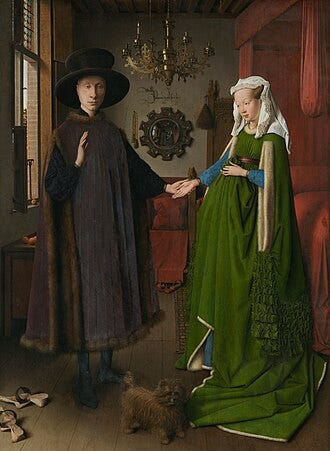
Decoding paintings is really fun. It’s like knowing a secret language. Take the saints, for instance. Artists have tended to follow the same tropes for hundreds of years when painting the saints, and if you know which accessories go with which saint, you can identify who’s in the picture. Old guy with keys? That’s St. Peter, holding the keys to the kingdom of heaven. Hot guy with a bunch of arrows in him? That’s St. Sebastian, martyred for his belief in Christ. Chick holding a towel with a picture of Jesus on it? That’s St. Veronica. She gave Jesus her veil to wipe his face with while he was carrying the cross, and afterward his face appeared on the veil (vera for true + ica for icon or image = veronica).
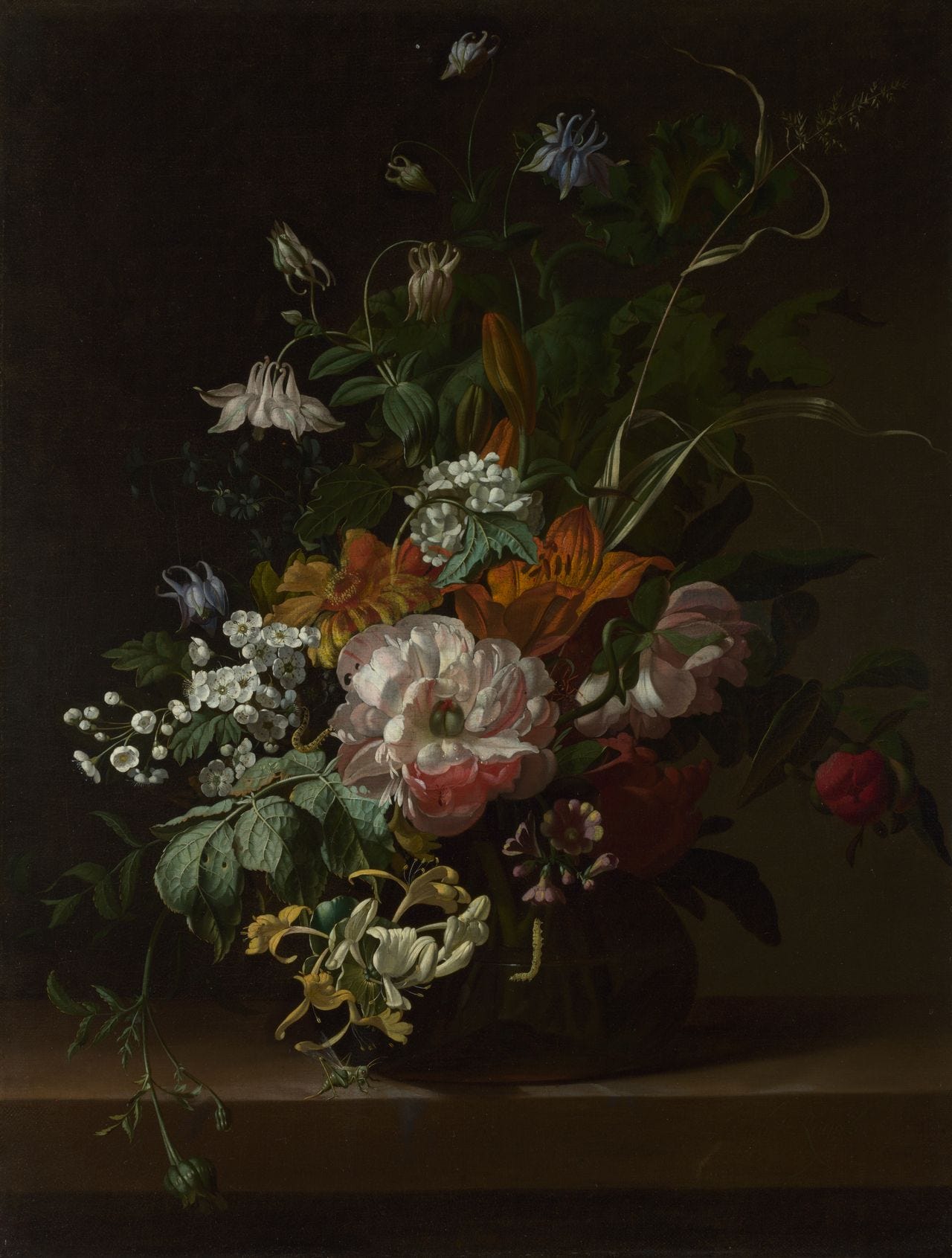
Flowers also tend to have consistent meanings across paintings. White lilies signify the Virgin Mary while poppies can connote death, roses are for love and tulips are for prosperity. Unless the flowers are wilting or dead in which case they’re there to remind us we too will wither and die.
In art history, the artist’s intent is paramount. Your reaction to the work—how it makes you feel, what you think it means, how you may incorporate that perceived meaning into your life—is secondary to what it “actually” means. And I say actually in quotes because intent and meaning are highly debatable among scholars, especially with very old paintings where little is known about the artist and little if anything survives of their personal writings to help us get into their head. It’s all (well-informed and usually well-intentioned) conjecture.
Take the following two paintings by Frans Hals. The first is the Regents of the Old Men’s Almshouse and the second is the Regentesses of the Old Men’s Almshouse. both painted in 1664.
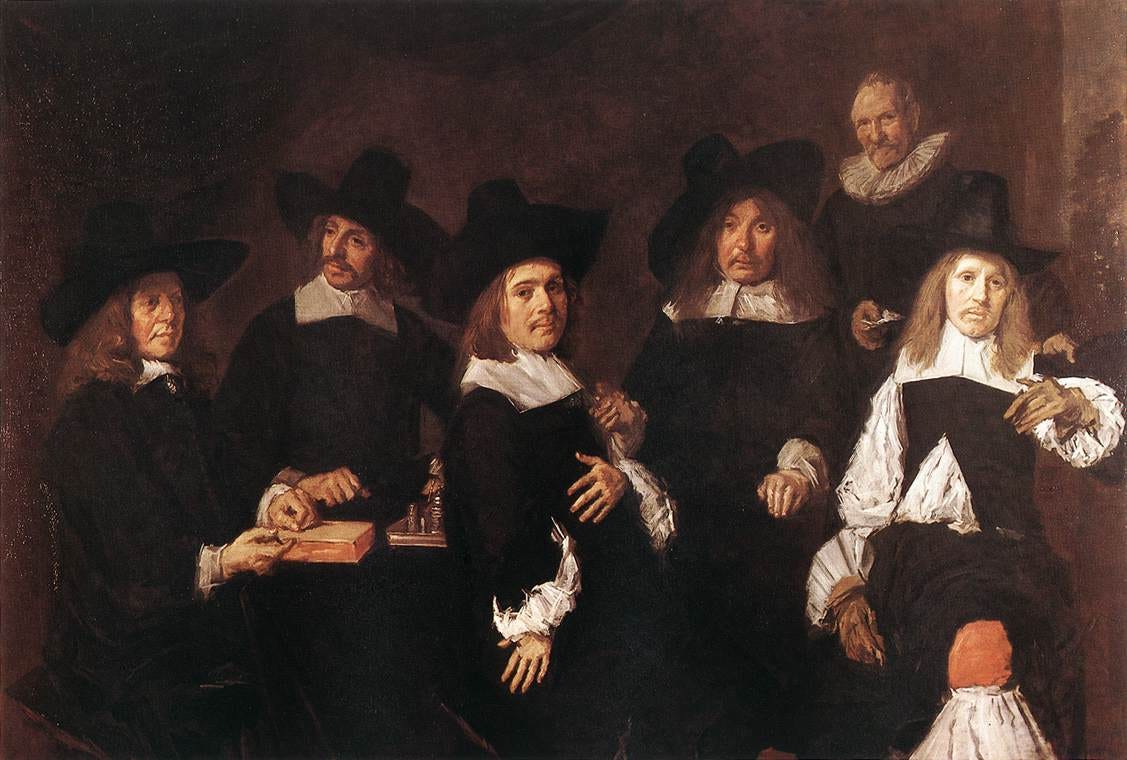
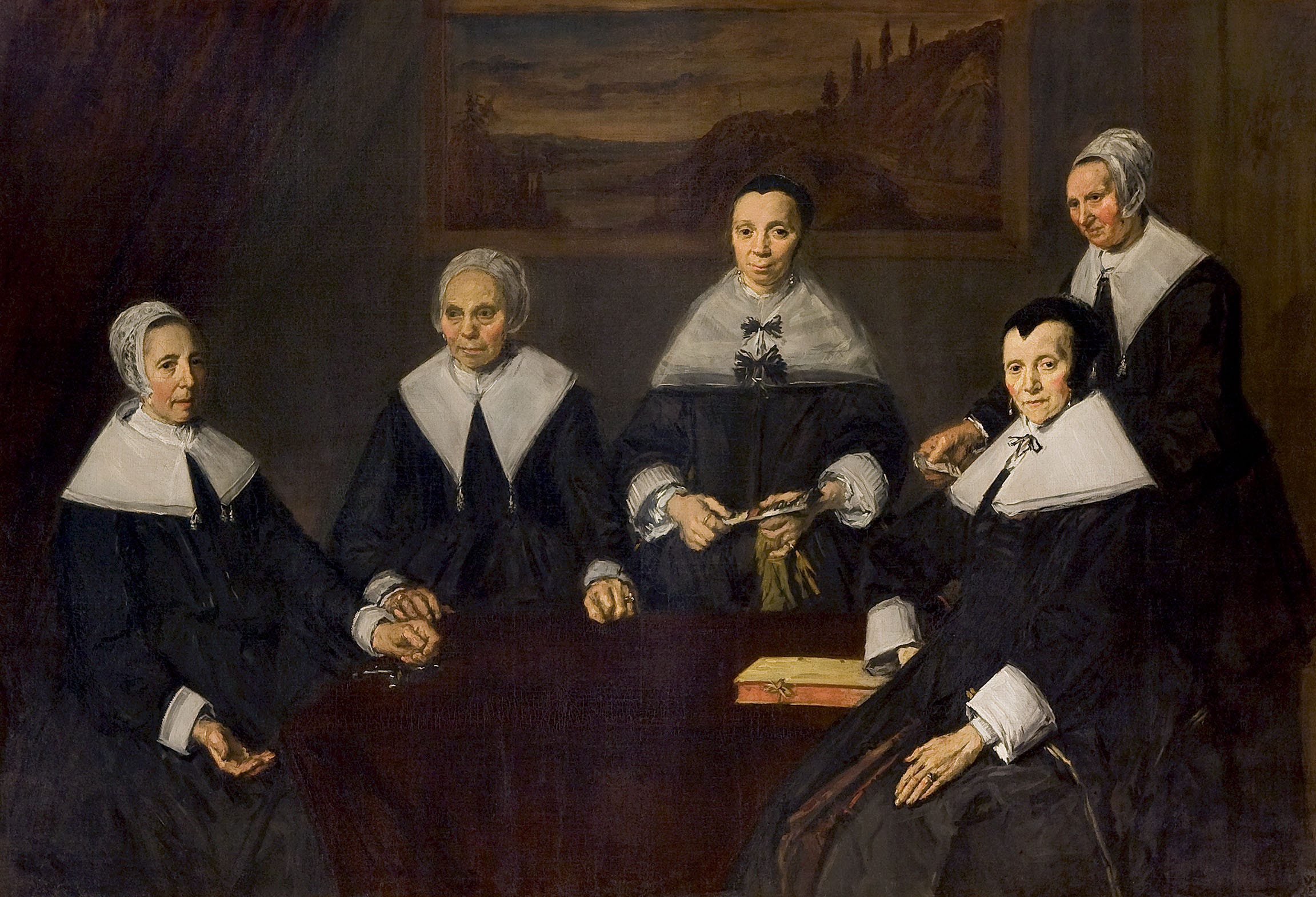
What do we notice? They’re painted in a very loose style, typical of Hals’s late work. These are, in fact, commonly believed to be his last two paintings. They’re very dark. Vincent Van Gogh famously remarked to his brother Theo that Hals must have had 27 shades of black, as there’s so much variability of tone when you see his paintings up close. The sitters don’t look particularly happy, nor do they even look nice. The three men on the right side of the portrait form an odd triangle with faces that seem to convey drunkenness, menace, and sloth, respectively. The men on the left, especially the third from the left, seem better disposed, if a little aloof. The women all look aggrieved and sallow, with the one all the way on the left and the second from the right in particular fairly glowering out at the viewer. For the benevolent patrons of a charity institution, these are hardly flattering portraits of their goodwill and inner light.
In his seminal book on art history, Ways of Seeing, John Berger tells us that Hals was a chronically destitute man who’d narrowly avoided freezing to death by begging for three loads of peat moss in the winter of 1664, the same year in which he painted these portraits of the very people who would have been in charge of doling out charity and deciding who was worthy, and who was not. Knowing this background necessarily changes how we view the paintings, from two group portraits of fairly severe Dutch Protestants to social critique.
Berger takes issue with traditional art historical scholarship that would say Hals was an objective observer, not allowing a petty thing like the fact that he’s alive only due to the whims of the people in these paintings keep him from making them look their best. And maybe this is their best. Maybe he was an objective observer. The paintings were well received and were hung in the Almshouse, which is now the Frans Hals museum. As far as we know, the people in these paintings, including Drunky McSaucedalot, were happy with how they turned out. But still. Told the background, we can’t un-know the relationship Hals would have had with his sitters, and the power asymmetry therein.
Berger writes: “…the Regents and Regentesses stare at Hals, a destitute old painter who has lost his reputation and lives off pubic charity; he examines them through the eyes of a pauper who must nevertheless try to be objective, i.e., must try to surmount the way he sees as a pauper. This is the drama of these paintings. A drama of an unforgettable contrast.”
We don’t know for certain what Hals’s feelings were about his subjects, but we can infer a great amount, and that intent, whether he strove to be objective or sly, colors what we see in his paintings, and how we react to them.
Artistic intent is everything, we are told when we study art history, but this is interesting to me because it is not necessarily the same way in writing.
Like I said I studied art in college, not literature. I’ve regrettably never taken a college literature class, and so I’d never heard the term, “literary theory” until a few months ago. I won’t go too deep into it because a lot of it is far over my head (I’m currently working through these free Yale seminars right now and they’re great, if very dense.) But literary theory attempts to answer the questions: What is literature, how is it produced, how can it be understood, and what is its purpose?
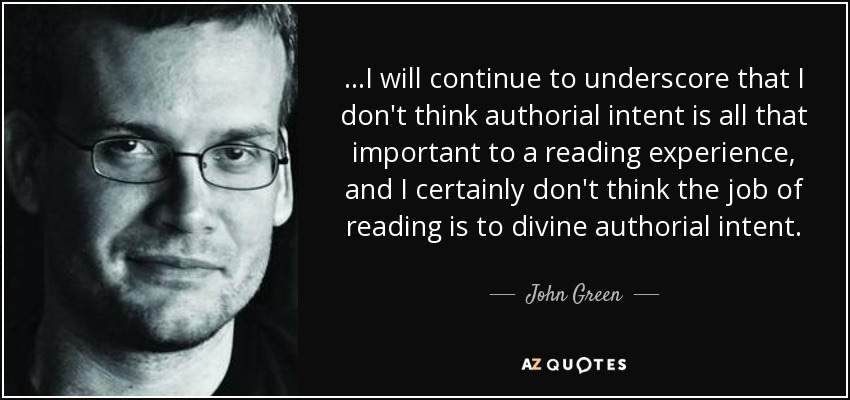
‘How can it be understood’ is the area I want to speak about briefly, because I believe most contemporary scholars, critics, and writers agree with Roland Barthes (and John Green), that authorial intent is secondary to a reader’s response to a work. “The birth of the reader must be at the cost of the death of the author,” Barthes wrote in 1967. The reader creates meaning in a book, not the author. She brings with her all her history, prejudices, loves, fears, and expectations to the reading experience and produces a response symbiotically with the text. Each book is personal to each reader, no two people coming away from a book having had the same experience, nor deriving precisely the same meaning.
Is Great Gatsby’s Daisy Buchanan a tragic figure hemmed in by mens’ expectations, or a money hungry skank who ended up with what she deserved? Different readers will have different opinions, and they’re both probably right.
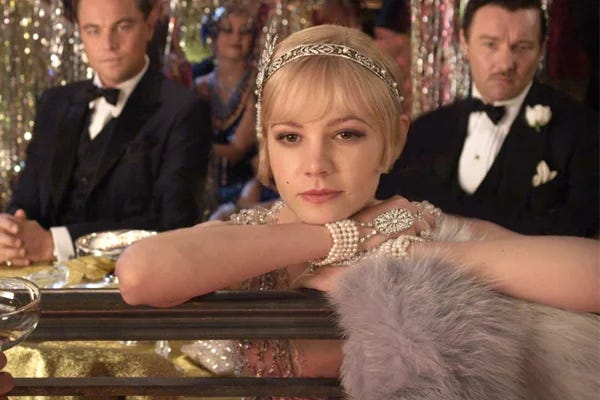
I think (some) readers hate this. I think the emphasis in high school English classes on figuring out the author’s intent, on decoding the symbols and themes of a novel to arrive at some A+ über-meaning such that all ambiguities are erased is very tempting, but can also be frustrating and maybe fruitless. When I do book events I often get questions about what I meant, or what a certain thing was meant to symbolize. All of this is fair and I don’t mind answering these questions. I have them myself. I’m not sure I’ve ever truly understood the meaning of the red rose petals in American Beauty.
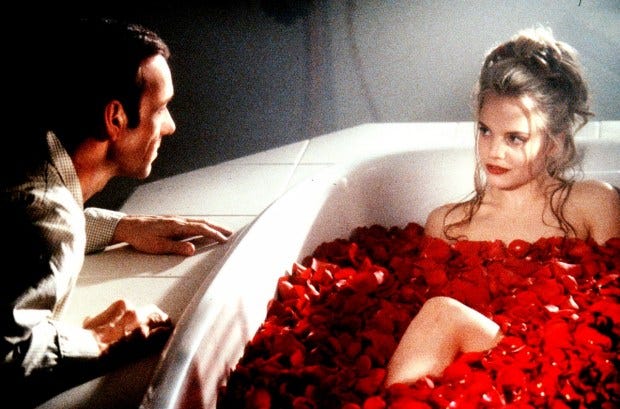
I try to answer these questions as best I can, but I often do the annoying thing authors (and therapists) always do and ask the reader what they think a particular thing means. Because I don’t think it matters very much what I think. There’s no DVD commentary on a novel. You can’t text me while you’re reading to see what I meant on page 35 when I said the campfire smoke was making a shape like a mountain. You’re ingesting the book and part of that is deciding what it all means.
If I start describing a tense date at a fancy French restaurant, you’ve immediately got a picture in your head. Even if I tell you the tablecloths were blue instead of white and the restaurant was in suburban Syracuse in winter instead of trendy SOHO in summer, you’re already coming to the story with your own images that conform to your own ideas of “fancy,” “French,” and “restaurant” as well as “tense” and “date.” I’m giving you most of the story and forming most of the picture in your head, but it’s impossible for me to say everything that could be said. A gap will always open up between what I say what you perceive. That gap is where the meaning of the work is made.
So this is the question I’ve been thinking about this week. Why does artistic intent matter so much in visual art, but less so in creative writing? I don’t have an answer. Maybe contemporary art is as open to interpretation as contemporary literature, and my examples from 400 years ago can’t be analogous to anything created today. Maybe writers in the 1600s were also working with established tropes and symbols and thus we should view their work as something to be decoded and understood rather than as something to be subsumed into ourselves. Maybe (probably) I haven’t through through the question enough to have a satisfying answer. Does context matter in the case of Hals’s paintings of his benefactors? I think so. But then again maybe I’m putting too much of myself into the interpretation, killing the painter at the cost of privileging myself as the viewer.
Stuff I’ve read:
I just finished The Baby on the Fire Escape, a fascinating look at how creativity and motherhood often do not coexist peacefully. By examining the lives of artists and mothers like Doris Lessing, Alice Neel, Ursula K. LeGuin, and Audre Lorde, the author attempts to understand how one may be a great artist and a great mother, or whether one role must perish in pursuit of the other.
I also just read Twenty Minutes of Silence by Helene Bessette, which was a long poem about a murder. Inspired by a true story, Bessette’s novel wrestles with the story of a teenage boy accused of killing his father and the fact that the family waited twenty minutes after the murder to contact authorities. I was skeptical, but was very quickly engrossed and loved how it deals with ambiguity and speculation.
I had a recent event with Isabelle Mongeau, author of the new fantasy saga, The Debtor’s Game. In Mongeau’s novel fairies are born saddled with debt to the high fae who lord over them, and wear these debts in the form of tattoos all over their bodies. Timely, disturbing, and all-too-real, this is a novel that will stick with you.
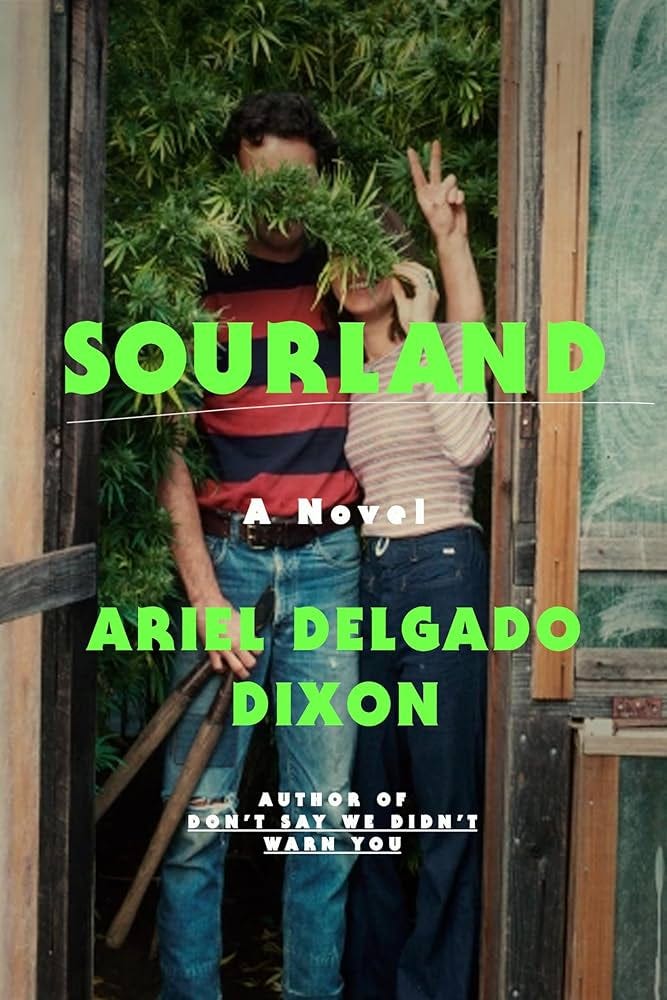
And finally, Sourland by Ariel Delgado Dixon, a dirty, sexy novel about a love triangle between three weed farmers, and what happens when one of them unexpectedly disappears. Dixon is an actual farmer herself, and her writing sparkles with the first-hand descriptions that can only come from someone who’s sweated through a harvest and pulled a newborn calf wet and wriggling from its mother.
Upcoming events:
And if you’re in the Boston area, I’ll be doing an event with Paul Tremblay on 6/30 at Brookline Booksmith for his new novel Dead But Dreaming of Electric Sheep.
And I’ll be hosting Gish Jen at Porter Square Books in Cambridge on 9/22 for her latest book, Bad Bad Girl.
xoxo,
Elizabeth
So insightful and fun and helpfully thought-inspiring. Thank you! I nodded Yes through the whole essay but came away with a firm signal from somewhere in my reading and viewing experience that, FOR ME, there's no difference whatsoever. That meaning always and forever will be "found" or "determined" by the reader/viewer/listener as they come upon any work of art. At the same time, meaning(s) can deepen, layer, veer off course, contradict each other (even in the same person) as we are exposed to other POVs including creators', or teachers'. Meaning(s) even arise or get shaded depending on what mood we're in, and/or the histories and lore that have shaped us. AND YET, the great magic and mystery for me as a "maker" is that "something" in my intention matters. It translates (or doesn't) to people I don't know and never will. Sometimes uniformly. Sometimes not. It so reminds me of theater from the production, not performance side of things. (I know you share my background in this regard) As a director, designer, I'm busy doing everything I can to be sure that when an audience encounters this work--in my absence--they will have experiences I'm hoping for them, stories that cohere (or don't, if that's what I'm hoping for). I wrestle with all of this taking editors' notes and revising. I don't wrestle at all when listening to readers or audiences. There the miracles are revealed: what has come through given the secrets I have regarding intention? What has gotten garbled? What aspect of the work of art that I didn't know was there is the very one that seems to have grabbed most folks who've come upon it? Too often I flog myself with these questions, measuring "success" in some relationship to my heart and my works in the world instead of enjoying the mystery, the mystery....And oh, btw, the old Open Yale Courses podcasts (2009) on "Dante in Translation" (https://podcasts.apple.com/us/podcast/dante-in-translation-video/id341650845)are wonderful.
This helped me see some recent creative hangups/unnecessary pressure on myself in a more digestible way!! Thank you!!