
Silences and why I'll (probably) never be an art monster
On the gaps between work

It’s been a minute, y’all. Not that I’m vain enough to believe you’ve been sitting at home, waiting for a new Substack from me. But in case you were keeping score at home it’s been one year and three days since my last post. I hadn’t intended to put an entire year between the last post and this one, but that’s just how things worked out. And it turns out there’s quite a lot to say about silences and hiatuses, the intervals between published work, and what that elapsed time can tell us.
Tillie Olson, who lived from 1912 to 2007, was among the first generation of American feminist writers. Her most famous short story, “I Stand Here Ironing,” has been widely taught and anthologized, and speaks on parenting in an unsupportive society, and the dreams and hopes mothers often have to put on a shelf in the service of raising their children—realities Olson knew intimately. She began writing in the 1930s, but did not publish her first short story collection until 1961, due to the demands of housework and raising her children.
In 1978 she published her landmark work of literary criticism Silences, which explores the gaps in the resumes of women and working class writers who had to step away from their art, sometimes for decades, because they were looking after family members, making a living, suffering illness, or otherwise fighting the myriad societal forces ranged against them.
“Literary history and the present are dark with silences … I have had special need to learn all I could of this over the years, myself so nearly remaining mute and having to let writing die over and over again in me. These are not natural silences—what Keats called agonie ennuyeuse (the tedious agony), that necessary time for renewal, lying fallow, gestation, in the natural cycle of creation. The silences I speak of here are unnatural: the unnatural thwarting of what struggles to come into being, but cannot.”
Herman Melville is one such writer whose career was stifled throughout his life by his Customs House job, leaving only evenings and Sundays to write. In a letter to friend, Nathaniel Hawthorne, he complained, “Dollars damn me. The calm, the coolness, the silent grass-growing mood in which a man ought always to compose, that can seldom be mine.”
Laura Ingalls Wilder didn’t begin writing until her sixties, as it wasn’t until then that she had the “silent grass-growing mood” necessary to get her stories down on paper. Any mother (or modern worker) knows that distraction reigns when other people are around (or, thanks to technology, even when they’re not). And distraction is absolute poison to writing. Olson writes:
“More than in any human relationship, overwhelmingly more, motherhood means being instantly interruptible. It is distraction, not meditation, that becomes habitual; interruption, not continuity.”
Writer Aubrey Hirsch expressed this beautifully in a recent comic she posted to Instagram.
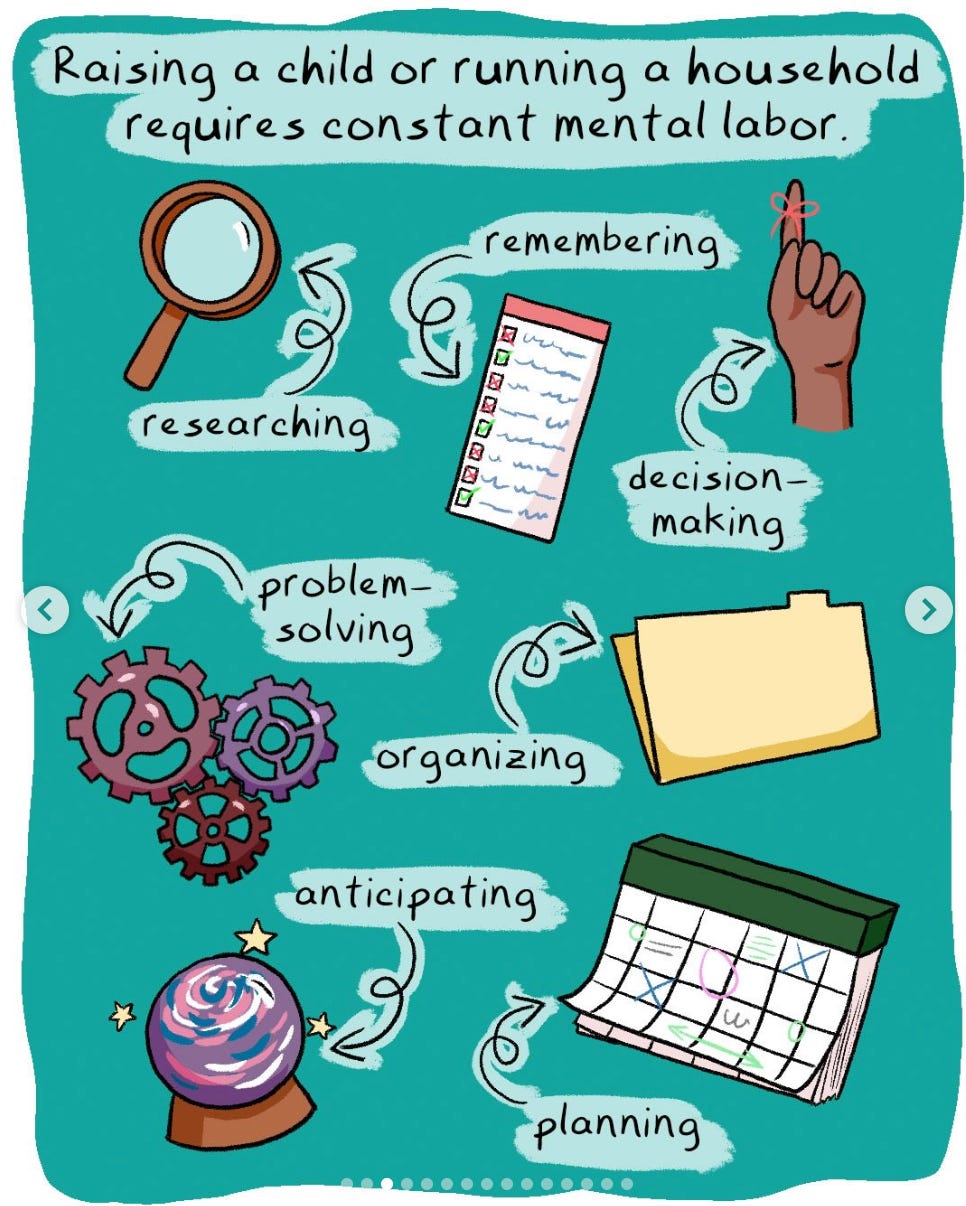
It’s not just the interruptions, but the mental load, that feels so taxing many days. Remembering everything from which kid eats which food, to what upcoming events require gifts, to unpaid bills, to bathroom breaks for the dog—can fill every available space in the brain, and the endless to-do lists engendered by this remembering can make the day feel like standing on one side of a tennis court swatting away a constant stream of balls. No matter how many tasks you knock away, more just keep coming.
So this brings me to the last year and what I’ve been up to: A lot. And not a lot. I published interviews with Cleyvis Natera, Silvia Moreno Garcia, A. Natasha Joukovsky (whose Substack is delightful), Bret Anthony Johnston, and George Saunders. I won a Mass Cultural Council Arts Grant. I was on the awesome podcast, Finding the Throughline (Part 1 and Part 2). I was named a Writer in Residence at Porter Square Books in Cambridge. I saw Keanu Reeves and Alex Winter in Waiting for Godot on Broadway. I gave lectures in Chicago and Boston. I did events in Provincetown and Baltimore. I planned a bar mitzvah, built a veggie patch (and subsequently grew about 250lbs of tomatoes and squashes, no cap), renovated the entire upstairs of my house, threw a big holiday party, learned to read Torah, (nearly) completed the Duolingo course on Finnish, bought a bike, and took yoga, Zumba, and ballet classes for the first time ever. I read 68 books.
What I didn’t do, however, was finish Letter To My Husband’s Mistress, my novel in progress.
I have been working on it. Truly. I wrote 1.75 pages yesterday. But the fact that it’s not done is driving me crazy. Especially as I’d begun it with so much wind in my sails, that I believed it would be the first easy project I’d ever undertaken. That artistic unicorn that just sort of comes out right the first time. The first 60 pages flew from my fingers onto the keyboard. Then the next sixty pages came a little slower, and were stymied by a lot of personal and professional interruptions, but they came, if not easily, then without the maximum of effort that went into, say, 90% of The Bullet Swallower. That book was a slog from day one. But LTMHM was always different. It felt fully formed in a way my other books hadn’t, and all I had to do was just capture the feeling before it got too distant.
But last year got complicated. My father-in-law passed away, The Bullet Swallower film adaptation stalled, and I was burned out by a very hectic 2024 spent writing, traveling, promoting, and getting a crash course in screenwriting in situ in Hollywood. I’d hit a wall. And though I tried to write, most days I’d open the Word document, get completely overwhelmed at the thought of having to decide what would happen next, and then scroll Reddit for 3 hours. It was not fun.
I was flailing around for answers and came across The Artist’s Way by Julia Cameron, a self-help guide for anyone trying to tap into or recapture their creativity. It was helpful, though her insistence on daily free writing was far too big of a commitment for me, despite that I believe it works. I also read Bird by Bird by Anne Lamott, How Fiction Works by James Wood, Writing Down the Bones, and several other writing manuals, but after 6 or 7 books I realized the answer to my problem wasn’t going to be found through research.
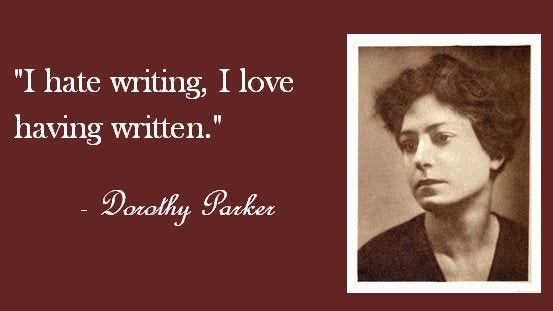
I just didn’t feel like writing. To let you in on a (not so secret) secret, I actually hate writing. And this isn’t uncommon. Lots of writers (most writers?) hate writing. For real.
Writing a novel is like trying to solve problems you don’t understand using tools that haven’t been invented yet. It’s unsurprisingly unpleasant to sit down and try to make decisions for an entire cast of make believe people, and try to make their decisions and problems interesting and relevant to another entire cast of potential readers, many of whom will hate everything you do no matter how well you do it. I’m not even going to get into the myriad problems and uncertainties facing the publishing industry right now. But even ignoring the professional perils, it’s just a lonely, ego-killing, emotionally debilitating job that requires you to be simultaneously vulnerable and impervious, humble and narcissistic, intro and extroverted, and above all, utterly selfish. Selfish about your time, your space, your investment in other people’s lives.
Even if I desperately wanted to write all the time, and loved the endless possibilities of a blank page, I always come up against the limitations of time. And we know that’s in short supply for all of us.
Writing takes TIME. T-I-M-E. So. Much. TIIIIIIIIIIMMMMMMMEEEEEEEEEEEE. Not just time to write but time to sit, to think, to pace around the room, to scribble things on paper, to lie on the floor with your feet elevated in a vain attempt to get more blood to your brain. To read. To sit some more. To print out everything you’ve written and shuffle it up and see if it’s better when it’s all out of order. Writers need time. Unbroken, uninterrupted, quiet, distractionless and solitary time.
I’ve already been writing this particular post for 4 hours, during which time I’ve had to take 2 phone calls, take the dog outside to pee, read and respond to 4 emails, answer 9 text messages, open the door to one visitor, and prepare myself lunch and coffee. And this is a quiet day when I don’t have anything else going on. But each interruption takes me out of what I was working on, and causes me to completely lose the thread of what I was saying. So I apologize if I seem to run off the tracks periodically in this post. I really did have a point when I started.
Jenny Offill coined the phrase, “art monster,” to describe a character in a short story who doesn’t get married, who devotes herself entirely to her art, who wears her selfish devotion to her work as a badge of honor. I’m not going to delve too deep into the term, as greater minds than mine have written dozens of think-pieces about the notion (Rebecca Solnit being one). But I bring it up because I think the phrase does correctly identify that to be a great artist, one must work at the exclusion of pretty much everything else. (See: The four-burner theory). Allegedly Nabokov didn’t even fold his own umbrella or lick his own stamps. And I guarantee you people are still going to be talking about Lolita in 500 years.
But I’m not Nabokov. I don’t have that kind of life. Most writers don’t. And that’s ok. But I think sometimes I don’t want to write because I know I won’t be able to conjure up that “silent grass-growing mood” as Melville so eloquently put it. If I can’t have all the time, my brain says, then I don’t want to spend any time.
I think about this when I think about the silences that exist between other writers’ books. How many silences are due to family, work, illness, money problems? And how many are due to the never ending volley of tasks lobbed at us on a daily basis? The “quick questions” and “tiny favors” and “do you minds” and “when you get a minutes” and “hey Moms” that pop up literally dozens of times a day.
I’ll finish my novel. I know I will. Eventually. But I want it to be done now because I have other things I want to do. But some days I’m just not able to carve out the time. When my life is over and reduced to a few lines on a Wikipedia page, I wonder how many entries I’ll have under the Bibliography section. How many years will have elapsed from one novel to another? What will people imagine I did in the spaces between?
Thank you for summing up every excuse, frustration and exhaustion that I go through on a daily basis.
Me too. Thank you!